City hosting info day about neighbourhood plan for Masiphumelele and surrounding areas
03 September 2025
The City of Cape Town encourages local residents, stakeholders and interested and affected parties to attend the information day about the draft Local Spatial Development Framework (LSDF) for Masiphumelele and the surrounding areas in the Far South on 10 September 2025. This is the ideal opportunity to ask questions and get more clarity on what the LSDF is proposing for the area.
‘The LSDF proposes a development vision and framework to manage urban growth in a sustainable manner, taking into account current challenges such as the encroachment of the wetlands area; the dire need for housing opportunities and improved access routes; the lack of public open spaces and recreation areas; facilities provision, and local economic opportunities for residents,’ said the City’s Deputy Mayor and Mayoral Committee Member for Spatial Planning and Environment, Alderman Eddie Andrews.
The information day is scheduled for Wednesday, 10 September, from 15:00 to 19:00 at the Living Hope Hall, no. 7 Kommetjie Road
‘Everybody who lives, works, and owns property in Masiphumelele and surrounding areas will benefit by attending this information day. We need residents to familiarise themselves with what is being proposed and how the spatial vision intends to assist with the current challenges. The intention is to collaborate with those who know the area well. We want to hear from you, and need you to submit ideas and proposals, and importantly, to be part of this process,’ said Alderman Andrews.
The LSDF takes into account the unique qualities and challenges of Masiphumelele such as its location and future growth, local opportunities for economic development, and the need for formalising informal settlement areas that are currently located within the wetlands area, amongst others.
The relocation of informal settlements out of high risk areas, and construction of a new road to improve access from Masiphumelele are key to the draft LSDF, including identifying possible land parcels in the area to support a range of housing opportunities.
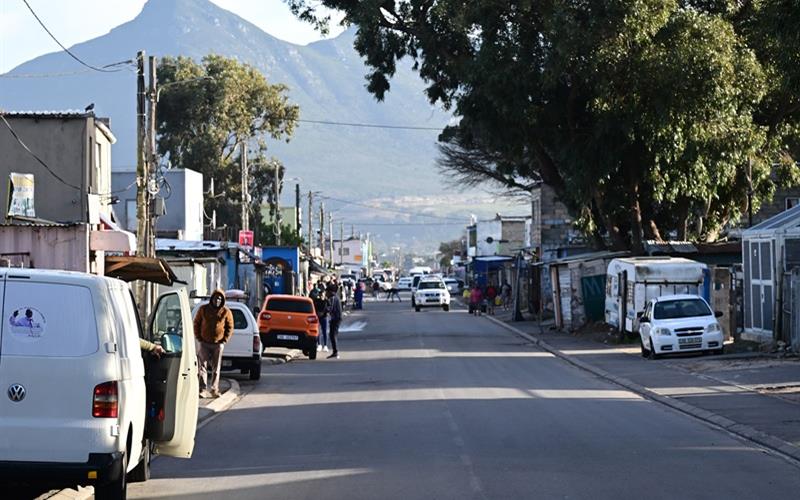
‘The draft spatial vision for the Masiphumelele area pursues a neighbourhood that is well integrated with the surrounding area so that residents can have easy access to jobs and other opportunities, have more choices when it comes to residential opportunities, and for Masiphumelele to contribute to the local economy. It is a broad vision, and must be sufficiently flexible to adapt to changing circumstances and needs,’ said the City’s Deputy Mayor and Mayoral Committee Member for Spatial Planning and Environment, Alderman Eddie Andrews.
The main objectives of the draft LSDF are as follows:
To provide a development vision to guide and manage urban growth, and broaden the choice of residential opportunities
To improve residents’ general living conditions
To balance competing land use demands, and to implement a sustainable development path
To spatially integrate Masiphumelele with the surrounding areas through improved access routes, and walking and cycle lanes
To improve residents’ access to employment, local facilities and essential services
The draft LSDF identifies a number of challenges in Masiphumelele and seeks to address these:
Severe overcrowding, high densities, and a growing backlog in social facilities and services provision. The estimated future housing need, for example, equates to over 10 000 units
The limited public and private land available for development – the City owns about 25% of the land in Masiphumelele, most of which is wetlands, parks, or intended for schools
The high risk of fire given the density and informal structures; and given the encroachment of the wetlands area many structures are flood-prone
Informal settlements encroaching on the wetlands, and the subsequent solid waste and waste water pollution
The location of the wetlands informal settlement is a major obstacle to providing a much needed alternative road and access to Masiphumelele with the planned extension of Houmoed Avenue
High unemployment
Congestion, and limited access into and out of the area
Limited provision for informal economic sector activities
Limited public transport services with households spending up to a third of their monthly income on commuting
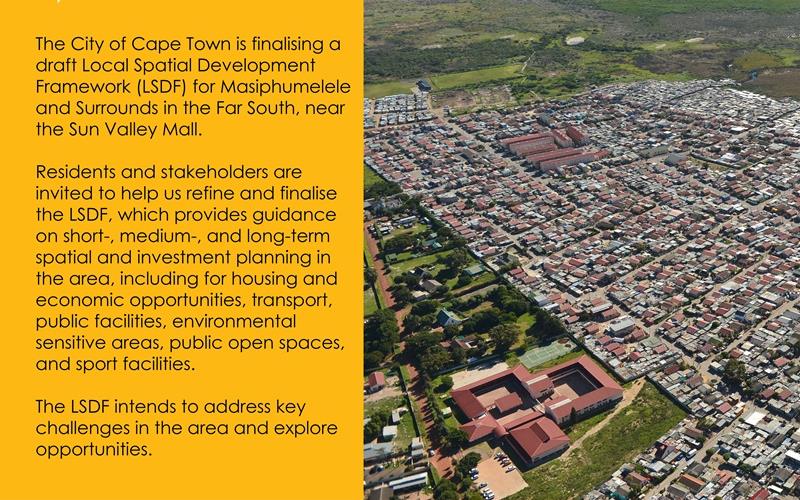 ‘The LSDF proposes an integrated approach to improve residents’ overall living conditions, including identified land parcels within and around Masiphumelele for housing opportunities. The LSDF also aims to support residents’ broader social and economic development needs, access to essential services, and integration with the surrounding suburbs through new road links, and pedestrian facilities. Importantly, there is a strong focus on improving the environmental conditions of the natural ecosystems such as the wetlands adjacent to Masiphumelele, and how this natural environment can enhance the quality of life and contribute to economic development,’ said Alderman Andrews.
End Published by:
City of Cape Town, Media Office